
Nirmal S. Nair
Computer Vision, 3D Reconstruction, SLAM, Spatial Computing
Home » Multi-View Stereo Reconstruction
Multi-View Stereo Reconstruction
Graph Cuts-Based Depth Refinement for Dense 3D Reconstruction
3D Reconstruction · Depth Estimation · Graph Cuts | Python · PyGMO · PyMaxflow
This project presents a depth map-based multi-view stereo (MVS) pipeline for reconstructing dense 3D geometry from calibrated images. The key idea is to refine depth maps for all pixels in an image simultaneously using a graph-cuts formulation, enabling global reasoning in low-texture regions where local methods often fail.
Published in IEEE Signal Processing Letters, 2022.
https://doi.org/10.1109/LSP.2022.3201778
Code: https://github.com/nirmalsnair/mvs-graphcuts
Overview
Multi-view stereo is fundamentally an ill-posed inverse problem: the system must recover 3D structure from a set of 2D calibrated views. In practice, depth estimation becomes especially difficult in homogeneous or weakly textured regions, where photo-consistency alone does not provide a strong enough signal to infer the correct depth.
We address this by combining coarse global depth search with graph cuts-based depth refinement. Instead of optimizing only a subset of pixels, the method refines depths for the entire image jointly, allowing smoothness priors and global information to guide ambiguous regions while preserving discontinuities at object boundaries.
Key Contributions
- Coarse-to-fine pipeline combining global search and discrete optimization.
- 3D grid graph formulation with offset vertices for depth refinement.
- Joint optimization of all pixels during refinement rather than processing only subsets.
- Improved reconstruction in homogeneous regions where local matching cues are weak or ambiguous.
Method

The pipeline follows a coarse-to-fine strategy, combining global search with graph-based optimization.
1. Coarse Depth Estimation
- Initial per-pixel depths are estimated on downscaled input images by maximizing ZNCC-based photo-consistency using Particle Swarm Optimization (PSO).
- Coarse depth maps are checked for cross-view consistency, removing unreliable estimates.
- Missing values are filled using cross-view depth map completion.
2. Graph Cuts-Based Depth Refinement
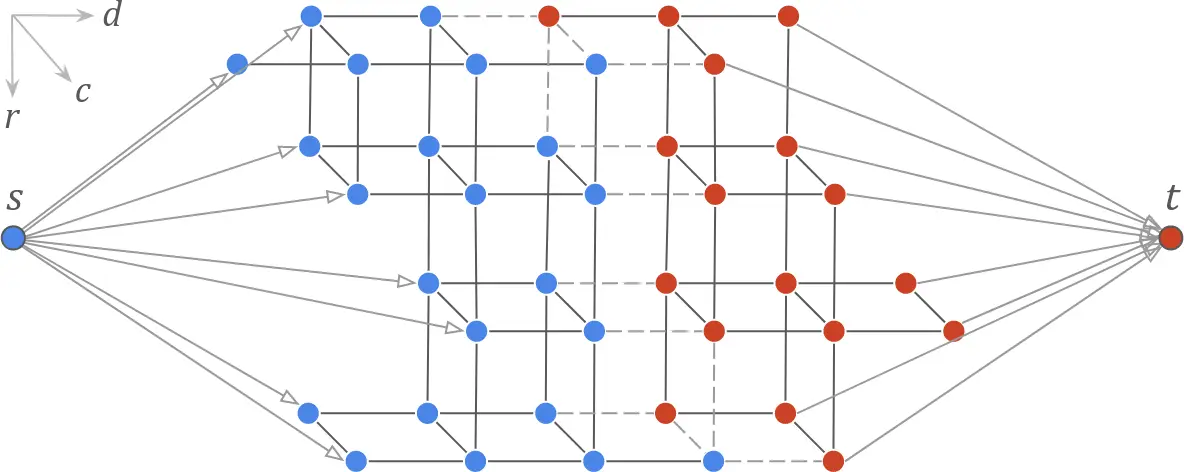
Graph structure for depth refinement of a 4×2 image with depth-levels d = 5 and vertices offset to account for different initial depths. The source partition S and sink partition T are denoted by blue and red nodes, respectively. The s−t cut edges are denoted by dashed lines.
- Coarse depth maps are upscaled to the original resolution and used as initialization.
- A 3D grid graph is constructed over discretized depth levels for each pixel.
- Vertices are offset along the depth axis based on initial coarse depths.
- Edge capacities encode the photo-consistency and smoothness terms of the refinement energy.
- Refined depth maps are obtained via the minimum s-t cut using the Boykov-Kolmogorov max-flow/min-cut algorithm.
3. Fusion and Surface Reconstruction
- Refined depth maps are projected into 3D to form a dense point cloud.
- A watertight mesh is generated using Poisson surface reconstruction.
This design makes it possible to use global information during refinement without incurring the full cost of unconstrained high-dimensional optimization.
Implementation
- Language: Python
- Core libraries:
- Additional tools:
- MVE (depth map visualization and point cloud generation)
- Open3D (3D visualization)
- Poisson Surface Reconstruction (mesh generation from point clouds)
Results
The method was evaluated on standard indoor and outdoor datasets:
- Middlebury TempleRing (47 views, 640x480)
- Middlebury DinoRing (48 views, 640x480)
- EPFL Fountain-P11 (11 views, 3072x2048)
- DTU Skull (49 views, 1600x1200)
Key observations:
- High completeness with minimal holes and outliers
- Strong performance in low-textured regions
- Robust to occlusions, lighting variations, and limited viewpoints
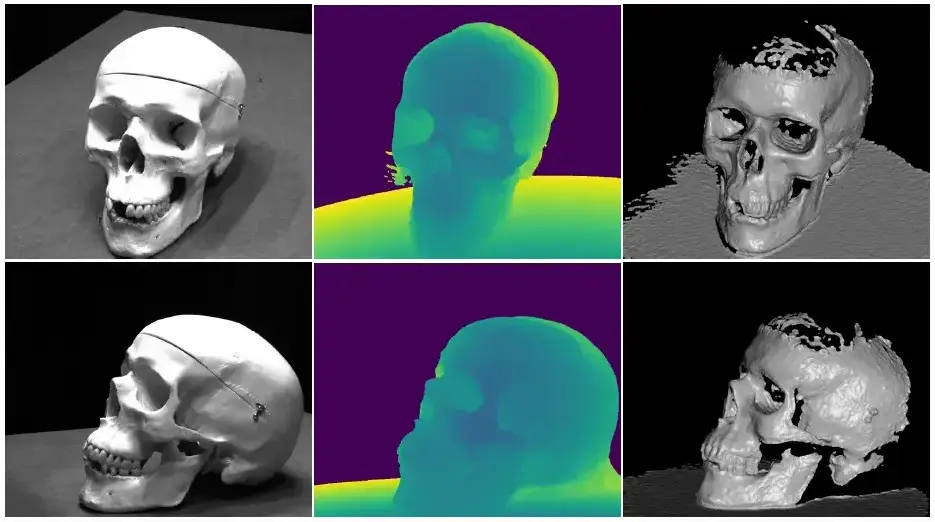
Input images, graph cut-refined depth maps, and reconstructed 3D model for the DTU Skull dataset.
Publication
Nirmal S. Nair and Madhu S. Nair, "Multi-View Stereo Using Graph Cuts-Based Depth Refinement," IEEE Signal Processing Letters, vol. 29, pp. 1903-1907, 2022.
This work shows how graph cut optimization can be applied to dense multi-view stereo refinement, enabling practical global optimization and improving reconstruction quality in ambiguous regions.